Maison Nouvelle bankruptcy and seizure
Promise at DawnMaison Nouvelle’s bankruptcy and seizure turned the financial strain of Romain Gary’s childhood into a public dispossession. After his prolonged illness and the family’s absence from Vilna, his mother’s fashion house failed, their furniture and household possessions were taken, and the family had to consider leaving. The episode is also a defining reversal in the mother-son relationship: the child who had depended on his mother now tried to protect her through a deliberately theatrical show of courage.
Causes and Financial Collapse
While Romain Gary recovered beneath the lemon trees and mimosas of Bordighera, his mother briefly visited Nice to explore selling her Vilna establishment and opening a fashion house there. Six weeks later, mother and son were back in Vilna, where it was clear that Maison Nouvelle could neither be sold nor kept operating. His illness had consumed the attention that the business required: during the two or three months it lasted, his mother neglected the firm while summoning specialist after specialist to his bedside. Paying those doctors left her deeply in debt.
The illness delivered the final blow to an enterprise whose apparent prosperity had already concealed a precarious financial reality. Although the salon was regarded as the leading fashion house in town, its standing outstripped its balance sheet, and the family’s way of life exceeded its means. They relied on new drafts to settle old ones. The problem was not simply a sudden shortage of customers or a single unpaid bill: maintaining the image of success was essential to retaining a clientele that might withdraw or demand lower prices at the first sign of trouble. His mother continued designing, overseeing fittings, and performing confidence for her patrons even as moneylenders pressed her to sign more promissory notes to cover interest on earlier loans.
She had also tried to preserve the family’s future through a separate reserve: the imperial silverware she had brought from Russia. She concealed the collection from creditors and bailiffs and had refused to use it, regarding it as valuable enough to support them for years after their eventual move to France and to finance her son’s education. That protected treasure remained bound to a future she imagined for him even as the business and their immediate security disappeared.
Bankruptcy and the Seizure
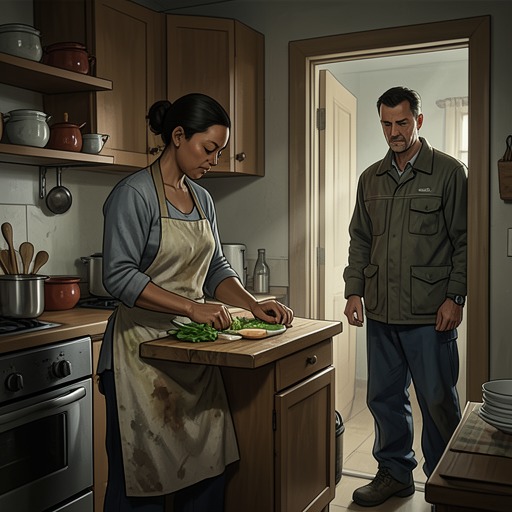
A few weeks after their return, desperate efforts to revive Maison Nouvelle proved futile, and the firm was declared bankrupt. The family’s furniture was seized. The removal transformed financial failure into a scene that Romain Gary remembered in physical detail: a bald, heavyset Polish bailiff with a waxed black mustache moved through the rooms with two assistants, inspecting dresses, armchairs, sewing machines, and the dressmakers’ dummies. His attention to the household’s belongings made the process feel invasive as well as ruinous.
The seizure stripped away the objects that had furnished the family’s image of prosperity. Romain Gary’s jodhpurs and riding crop were taken, leaving him in short pants and without the props of the cavalier role he had been taught to inhabit. Among the possessions being carried out, the chandelier had particular force as a sign of the past: by the time it was being lowered from the ceiling, the apartment had been emptied and the family’s former display of abundance was visibly coming apart.
A Child’s Performance of Protection
For the first time, his mother openly showed distress and turned to her son for help. Nearly ten years old, Romain Gary understood his duty as an obligation to appear steady, manly, and unconcerned. His response was not to stop the bailiffs but to make their presence the stage for a performance aimed at his mother. He obstructed their movements, stepped on their feet, stood in their way with his hands in his pockets and his stomach thrust forward, and whistled as if the loss left him unmoved. He even spat on a carpet as it was carried away and pushed the piano at the right moment, sending it down the stairs with damage to both the instrument and the wall.
The gestures were meant to reassure his mother that she was not alone and that he would one day restore what had been taken. In the last armchair, she watched him with a loving expression and cried only a little. When the bailiffs took that chair too, she joined the performance rather than withdrawing from it: she got up almost gaily, kept her eyes on her son, and beat time with her feet while he danced across the dusty bare floor with an imaginary partner. Their tango made the emptying apartment briefly into a shared act of defiance. It did not reverse the seizure, but it allowed the mother and son to confront it together, and to insist that the family’s most important bond had not been carried away with the furniture.
The Forced Decision to Leave
After the apartment was emptied, mother and son held a long conference about what to do and where to go, speaking French so the Polish bailiffs would not understand them. There was no question of staying in Vilna. Customers who had once courted his mother now looked away in the street. Their avoidance was not explained by snobbery alone: many still owed the firm money, and ignoring the family also helped them avoid acknowledging those debts. The collapse therefore continued beyond the business itself, into the family’s social standing and prospects in the town.
The episode closes not with recovery but with a decision forced by bankruptcy, seizure, and the rejection that followed. Its emotional reversal is contained in the child’s change of role: the helpless patient whose illness had helped bring the business down becomes, in his mother’s eyes and his own, her improvised protector. Yet the performance cannot restore Maison Nouvelle or keep them in Vilna. The imagined dance and the hidden silver preserve a sense of future possibility, while the empty apartment makes the immediate loss unmistakable.